Buy again? Yes — absolutely
After ~2 years the spend still feels right. Coffee tasted great from day one; the ritual of grinding, tamping and frothing is the point. Watch for sales in the ~£600–730 band.
← All reviews · Updated 28 Oct 2026 (Europe/London)
UK ownership review · SES878
An honest home-espresso review after about two years with Sage’s the Barista Pro™ in Black Truffle — mostly cappuccinos and flat whites, still frothing and tamping by hand. Specs from Sage/public UK sources; the ownership notes are mine alone.
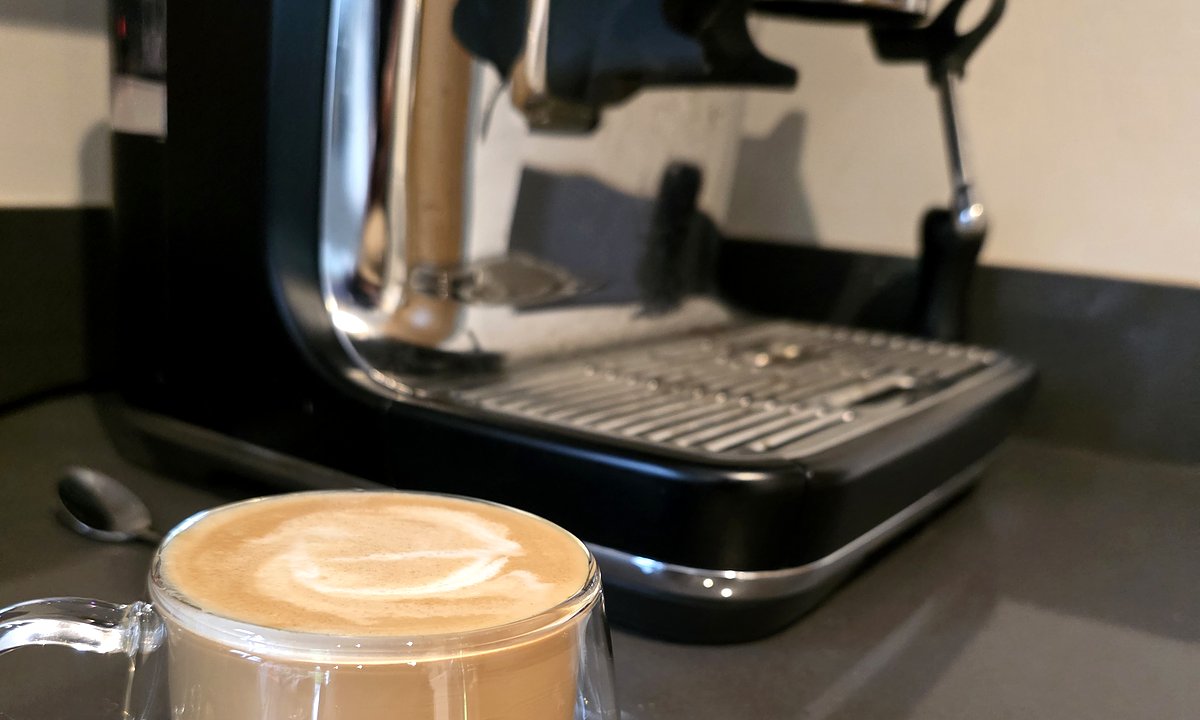
B07Q84SRQ8 · street price often ~£600–730 vs Sage list ~£729.95 (sales vary)
After ~2 years the spend still feels right. Coffee tasted great from day one; the ritual of grinding, tamping and frothing is the point. Watch for sales in the ~£600–730 band.
People who want café-style cappuccinos and flat whites at home and enjoy frothing milk, tamping the puck and tweaking to taste.
You’re on a low budget, or you just want to press a button and go. I’m not a pod person myself — if that convenience is the goal, buy a pod machine or a one-touch automatic instead of forcing this ritual.
I’ve owned a Sage the Barista Pro™ (SES878) in Black Truffle for about two years in the UK. I bought it myself. Most days I make cappuccinos and flat whites. I’m not a café trainer and I’m not paid by Sage — this is a lived-in ownership review with public specs where helpful, and clear Amazon Associates disclosure where I link out.
I won’t invent kitchen drama. If something below is a manufacturer claim (heat-up time, wattage, pump pressure), it’s labelled as such. If it’s my experience, it’s from those two years with this machine. Accessory cards marked I use this are kit I actually run (scales, tamper, distributor); everything else is a common add-on tip or a rotation suggestion — labelled honestly.
The Barista Pro sits in Sage’s home espresso line as a semi-automatic machine with an integrated conical burr grinder. You grind into a 54 mm portafilter, tamp, extract, then texture milk on a manual steam wand. Sage markets ThermoJet™ heat-up to extraction temperature in about three seconds, PID temperature control, low-pressure pre-infusion into a ~9 bar extraction path via a 15-bar Italian pump, an LCD with volumetric 1- and 2-cup controls, and Baratza European precision burrs with 30 grind settings.
Retailers sometimes file it under “bean-to-cup” because beans go in the hopper — but it is not a fully automatic one-touch machine. If your mental model is “press a button, walk away with a latte,” look elsewhere. If your mental model is “I want third-wave style control without buying a separate grinder on day one,” this is the category.
Positioning and claims: Sage UK product materials for the Barista Pro / SES878 · BES878 family.
I bought the Barista Pro because I wanted the hands-on ritual — frothing my own milk, tamping the grinds, and tweaking until the cup matched my taste. That still gets me going after two years. Most days I’m making cappuccinos and flat whites, not straight espresso alone.
The machine rewards that habit: dose, tamp, extract, steam, wipe the wand, drink. It’s slower than a pod — and I’m not really a pod person anyway. For me the process is the product, not a bug to automate away.
Coffee tasted great from the first day. I still spent a couple of weeks fiddling with settings, but that was because I enjoyed testing everything and finding new ways to make drinks I loved — not because the machine was undrinkable out of the box.
If you’re the sort of person who likes dialling grind and shot time, those early weeks feel like play. If you find that stressful, you may prefer something more automatic (see who should skip, below).
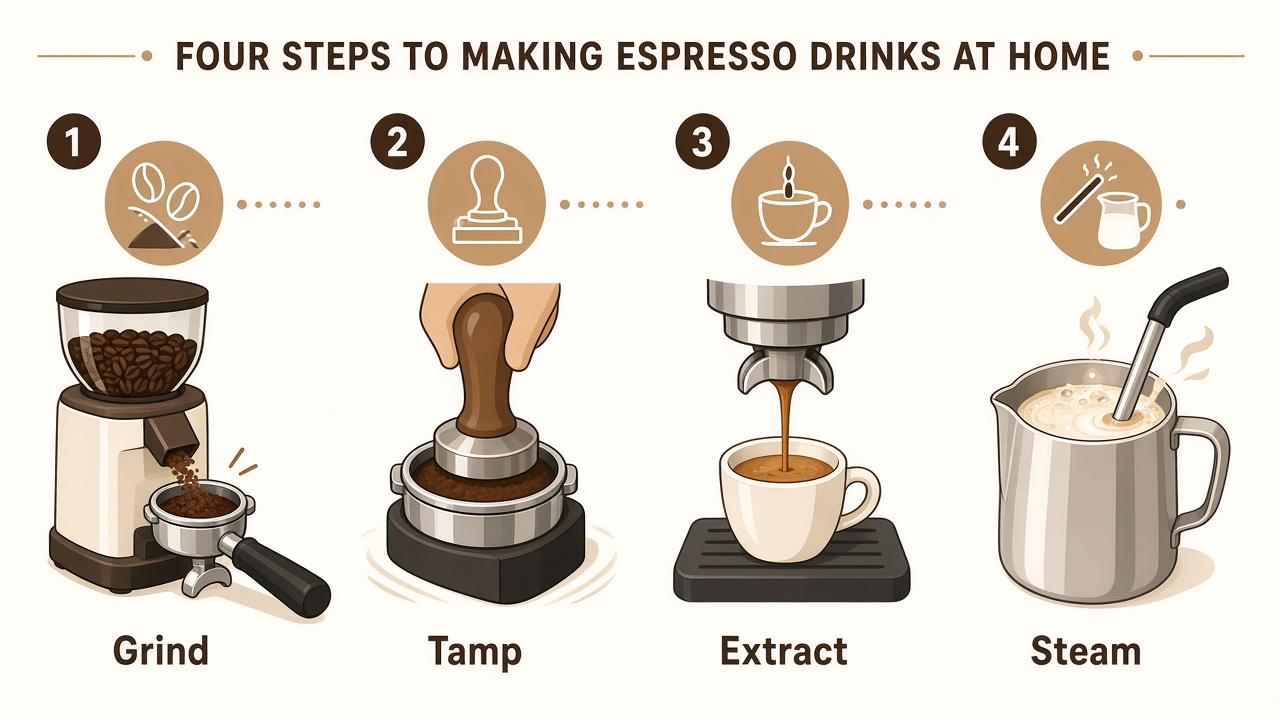
In practice the loop looks like this on any SES878 finish:
That last wipe matters — milk wand hygiene is one of the two friction points I notice every week.
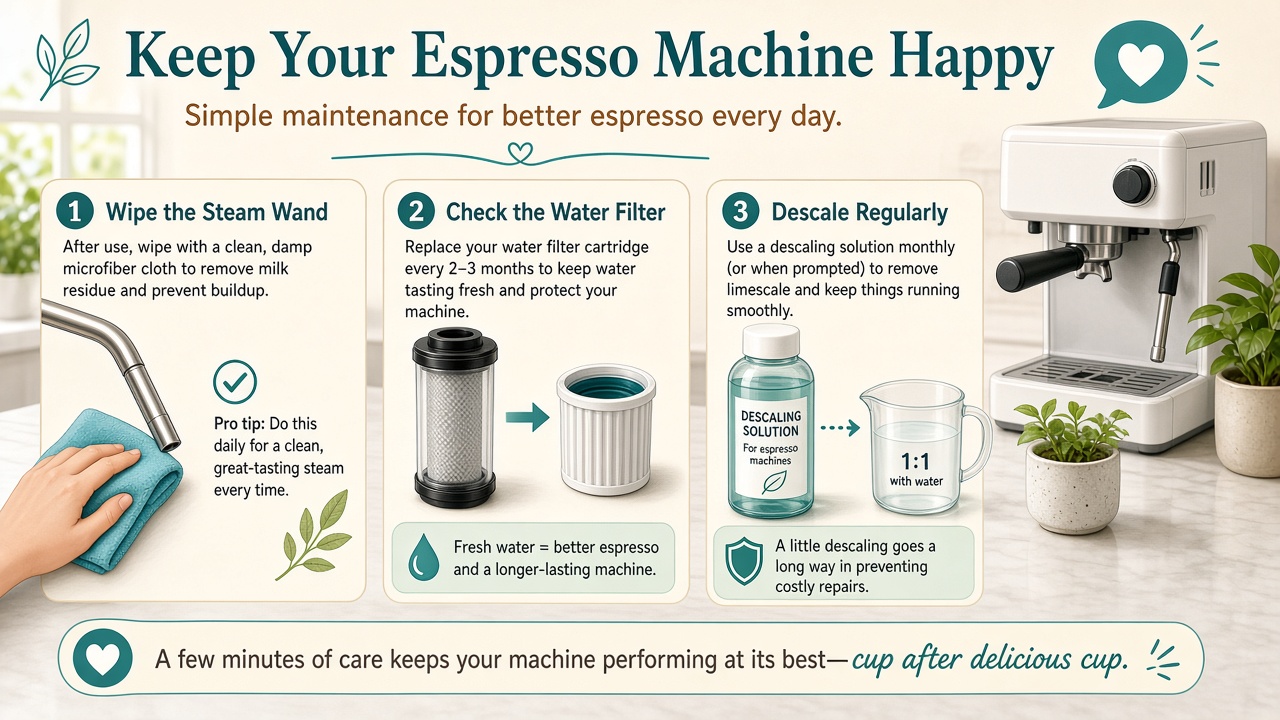
The biggest daily friction for me is descaling and cleaning the milk wand. Nobody buys an espresso machine for the privilege of scrubbing a steam tip on a Tuesday — and yet here we are. It’s the maintenance tax of a proper wand and daily milk drinks. Not a deal-breaker; just the honest chore that comes with the ritual I actually enjoy.
Expect ongoing consumables: water filters, cleaning tablets / powder, and the usual wipe-downs. Sage ships a cleaning kit and water filter with the machine; replacements are normal ownership, not a fault. I stick with genuine Sage / ClaroSwiss-style filters — they’ve been great for me.
Nothing has broken or needed repair in two years. The only replacements have been filters and similar expected consumables — normal upkeep, not failures. That’s the whole reliability story so far: uneventful, which is what you want.
Successful Sage / Breville review pages usually split kit into must-buy consumables (filters, tablets, descaler) and workflow upgrades (knock box, scales, better tamper). I’m doing the same — with a clearer honesty rule: cards marked I use this are kit I actually run alongside the Black Truffle SES878. Everything else is a common useful add-on tip, generalised in my tone from how owners usually kit these machines out. No fake “I’ve owned twelve knock boxes” stories.
These are the boring-but-important bits. My reliability story so far is “nothing broken — only filters and expected consumables,” and that matches how Sage expects you to run the Barista Pro: replace the ClaroSwiss-style tank filter on a ~90-day / hardness schedule, run cleaning tablets with the cleaning disc when prompted, and descale when the machine asks (hard-water UK kitchens more often). Filters don’t eliminate descaling forever — they stretch the gap.
The cartridge that sits in the tank. I replace these on a schedule with the expected consumables — and Sage filters are great. I stick with genuine Sage / ClaroSwiss-style cartridges for fit and peace of mind. Third-party clones exist if you’re chasing pennies; I’d rather not second-guess the tank chemistry.
Expected consumable · my preference is genuine Sage / ClaroSwiss-style.
Amazon.co.uk — Sage ClaroSwiss filter ASINB07B2WRNZD
For the group-head clean cycle Sage documents in the manual. If you pull milk drinks daily, oils build up whether you notice or not. Stock tablets before the machine nags you mid-weekday.
Common useful add-on owners typically buy — I haven’t named a personal favourite brand beyond “Sage-compatible tablets as expected care.”
Amazon.co.uk — Sage cleaning tablets ASINB07BBYKBY3 · model SEC250
Descaling is my biggest recurring chore alongside the milk wand — the machine’s polite way of saying “pay attention to the chalk in your kettle life.” Official powder sachets are what Sage points owners at; dissolve properly (many owners mix in a jug first) and follow the on-machine prompts. Stocking descaler just makes it less annoying when the light comes on. I haven’t locked a personal favourite third-party brand here — treat this as the must-have category.
General must-have consumable — not a claim about my exact tablet/sachet brand beyond Sage-compatible care.
Amazon.co.uk — Sage descaler ×6 ASINB0FN84H4KT
The Barista Pro already ships with a portafilter, baskets, tamper, Razor™ trimmer, dosing funnel (on current UK kits), jug and cleaning tools. The upgrades below show up again and again on strong accessory round-ups because they cut mess or tighten consistency — not because the machine is incomplete on day one.
Confession: day-to-day I still knock spent pucks into a bin. It works. It is also faintly undignified once you’ve spent several hundred quid on a ThermoJet machine — like owning a nice car and parking it by reversing into a hedge. A compact Sage knock box keeps the ritual tidy next to the drip tray and is the upgrade most long-form reviews eventually recommend. The classic Mini is the high-volume Amazon pick; Knock Box 10 comes in finishes that can match Sea Salt / stainless / Black Truffle kitchens. I don’t own one — I’m recommending it as a nice upgrade over my bin habit.
ASINsB00I69XEXM · B0CYHJT835 — pick colour on the live page · affiliate
Because my drinks are mostly cappuccinos and flat whites, milk texture matters as much as the shot. A jug with a temperature strip is the upgrade most milk-drink owners add once they’re past “just don’t burn it.” Sage’s Temp Control jug is the colour-matched option; the stock jug already works if you’re watching carefully. Common useful add-on — not one I’ve personally replaced (yet).
Amazon.co.uk — Sage Temp Control jug ASINB0154EJOJ4
I use these, and they’re incredibly good for consistency. Here’s the slightly nerdy bit coffee people won’t shut up about (and for once they’re right): the Barista Pro’s grinder doses by time, not by weight. Same timer setting, different bean density or roast age, and you can land a different grams-in-the-basket without changing a dial. If you’re even mildly OCD about repeatable flat whites, weighing the grounds (and/or the beverage) closes that gap. My coffee tasted great from day one without lab theatre — the scale just made “great” easier to hit again on a Monday. Skip if numbers spoil the joy; keep if consistency is half the hobby.
Amazon.co.uk — TIMEMORE Basic 2.0 (I use this) ASINB084FBMV1D
The stock Sage tamper gets you drinking. I stepped up to an IKAPE 53.3 mm calibrated spring tamper for more repeatable pressure in the 54 mm basket — it’s what I actually use now. (Sage’s “54 mm” ecosystem often takes ~53.3 mm base tampers; measure twice before you buy café 58 mm kit by mistake.)
Amazon.co.uk — IKAPE 53.3 mm tamper (I use this) ASINB0DTK59NT9 · affiliate · confirm base diameter on the live listing
I use a LEUOVE distributor as part of puck prep before the tamp — it helps level the grounds so the spring tamper isn’t fighting a wonky mound. Not magic; just less channeling lottery on busy mornings.
Amazon.co.uk — LEUOVE distributor (I use this) ASINB09WHXRWC4 · affiliate · confirm 54 mm compatibility on the listing
Consumable patterns from Sage manuals; “I use this” cards = my TIMEMORE Basic 2.0, IKAPE 53.3 mm tamper and LEUOVE distributor. Knock box = recommendation only (I still use a bin). Cleaning tablets/descaler = general must-haves, not a personal brand manifesto.
Buy beans to your taste. I often change every few months on purpose — keeps the taste buds honest and stops the hopper turning into a museum of one bag you stopped loving in week three. What’s below are highly rated whole-bean, espresso-friendly options on amazon.co.uk that suit milk drinks and home machines like the SES878. They are rotation suggestions to try, not “these are always in my hopper,” and tastes vary wildly. Check roast dates and reviews on the live listing.
A widely available Italian-style blend with chocolatey notes and enough body for cappuccinos and flat whites. Easy “change the bag” option when you want something familiar and creamy rather than experimental.
Amazon.co.uk — Lavazza Crema e Aroma ASINB000FWHWGS · affiliate
Often recommended for lattes and cappuccinos — fuller crema, stands up to steamed milk. A solid rotation pick when you want café-leaning milk drinks without hunting a local roaster that week.
Amazon.co.uk — Kimbo Extra Cream ASINB0040Y2L86 · affiliate
A fuller espresso-oriented bag that reviewers often pair with home barista machines. Good “shake up the hopper” candidate when you want more intensity than a mild supermarket blend.
Amazon.co.uk — Coffee Masters Full Bodied ASINB00Q0CSK5Y · affiliate
Freshness beats brand loyalty: check the roast / best-before date, buy what you’ll finish, and change bags when your palate gets bored — that’s the whole point of rotating.
Yes, absolutely — I would buy it again. At about the £600–730 band, the value of the spend has only increased over time and solidified the investment decision. Sage’s UK list price for standard finishes is often around £729.95; street prices and sales can land lower. The limited art finish sits much higher on Sage UK (around £1,099.95 when listed) — that’s a finish/art premium, not different brew hardware.
Prices move — check the live listing. Sales happen; I’m not promising a figure.I only own the Barista Pro. The options below are category alternatives successful review sites always cover — framed for budget and workflow, not as fake “I tested all three for a year” claims. If your budget or patience differs from mine, one of these may fit better.
If the budget is tight, I’d recommend the Barista Express. Same family ritual — integrated grinder, manual steam wand, 54 mm craft — usually for less money, with the older heating system / interface vs the Pro’s ThermoJet, LCD and 30-setting Baratza burrs. Choose Express when you want grind-tamp-froth without stretching to Pro money. Choose Pro when weekday ThermoJet pace and the LCD workflow matter (they do for me, which is why I paid up).
I do not own the Express — this is my budget recommendation + public positioning, not a side-by-side taste test.
Amazon.co.uk — Barista Express example ASINB07K29F7J8 (Black Truffle example — confirm finish on listing)
Bambino Plus gives ThermoJet speed and auto-assisted milk in a tiny chassis — but no built-in grinder. Pairing it with a decent grinder can match craft with more upgrade paths later, at the cost of two boxes and a different spend split. Choose this if counter depth is tight or you already own / plan a specialty grinder. Stick with the Pro if you want one coherent box and the manual wand ritual I enjoy.
I do not own a Bambino Plus — workflow framing only.
Amazon.co.uk — Bambino Plus example ASINB07GB2JVD7 (Brushed Stainless example — confirm finish)
Plainly: I don’t really enjoy coffee pod machines. If you want to press a button and go, don’t force yourself into a portafilter ritual on my account — pods and full automatics win on convenience. You just lose the frothing, tamping and taste-tweaking that sold me on the Pro. Different job, different person (see who should skip).
No affiliate push here — just the honest fork in the road.
Assisted-tamp models (Express Impress and friends) sit between “full manual Pro” and “press button”: useful if dosing mess puts you off, less so if control of the puck is the point — as it is for me.
Every finish below is the same Barista Pro performance and spec. Only the colour changes (the Aboriginal Culinary Journey art edition also carries a higher Sage list price). I own Black Truffle only — I haven’t lived with the others, but I’d happily recommend any finish you prefer aesthetically.
Finish names / SKUs: Sage UK Barista Pro page. Availability varies by retailer and date.
SKU SES878BTR4GEU1 · ASIN B07Q84SRQ8 · my machine
Amazon.co.uk — Black TruffleSKU SES878BSS4GEU1 · ASIN B07NPDSPKV · same performance
Amazon.co.uk — Brushed StainlessSKU SES878BST4GUK1 · ASIN B0B9HD9HLT · verify colour on listing
Amazon.co.uk — Black StainlessSKU SES878SST4GEU1 · UK ASIN TBD · availability varies
Search Amazon.co.uk — Sea SaltSKU SES878DBL4GEU1 · UK ASIN TBD · do not use US 120 V links
Search Amazon.co.uk — Damson BlueSKU SES878ART4GUK1 · premium art finish · Sage list often ~£1,099.95
Search Amazon.co.uk — ART finishFigures below are from Sage UK / major UK retail listings for the SES878. Dimension order differs between Sage (W×D×H) and some retailers (H×W×D) — check the source column.
| Model | Sage the Barista Pro™ · SES878 (UK) / BES878 family |
|---|---|
| Type | Semi-automatic espresso + integrated conical burr grinder |
| Heating | ThermoJet™ — Sage claims ~3 seconds to extraction temperature; PID control |
| Grinder | Baratza European precision conical burrs · 30 grind settings · ~250 g hopper |
| Portafilter | 54 mm · single- & dual-wall 1-cup and 2-cup baskets |
| Extraction | Low-pressure pre-infusion · 15-bar Italian pump · typical espresso path ~9 bar |
| Milk | Manual 360° steam wand · ~480 ml stainless jug |
| Water | ~1.9–2 L tank (retailers vary wording) · replaceable water filter |
| Interface | LCD · volumetric 1 & 2 cup · grind amount / menu controls · hot-water outlet |
| Power | 220–240 V · about 1380–1680 W depending on Sage/retailer sheet |
| Size (Sage) | Approx. 40.8 × 35 × 33.2 cm (W×D×H) |
| Size (Currys example) | Approx. 406 × 354 × 406 mm (H×W×D) — order differs; measure your niche |
| Weight | ~9 kg (retailer listings ~9.08 kg) |
| Warranty | Typically 2-year UK Sage guarantee — confirm on your pack |
| UK list (standard finishes) | Often ~£729.95 on Sage UK; street/sale commonly lower (~£600–730 band) |
Sources: Sage UK Barista Pro; Currys / Amazon.co.uk listings for SES878.
You enjoy frothing your own milk, tamping the grinds and tweaking to your perfect taste. You want cappuccinos and flat whites at home with café-style control, and you’re happy that the process is part of the product.
You’re on a low budget (look at the Barista Express first), or you’re just looking to press a button and go. I’m not a pod person — but if pods or a fully automatic match how you actually live, buy those instead of pretending you’ll tamp every morning.
For me, after ~2 years with Black Truffle: yes. I’d buy again in the ~£600–730 band. Value has increased over time, and you can sometimes catch it on sale. Worth it if you like the craft; not if you want one-touch convenience.
No. It grinds beans and makes espresso, but you still tamp, extract and steam manually. Retail “bean-to-cup” labels can confuse shoppers — treat it as semi-automatic with a built-in grinder.
Yes. Same SES878 hardware and performance; only colour differs (art edition is a premium finish/price, not a different brew system).
Public Sage positioning: Pro gets ThermoJet (~3 s claim), LCD controls and Baratza precision burrs with 30 settings. Express is the older sibling, often cheaper — and what I’d point someone at if budget is the blocker. I don’t own the Express, so I won’t invent a taste comparison.
Sage UK materials describe Baratza European precision conical burrs with 30 grind settings on the integrated grinder.
Optional to start — coffee tasted great from day one. I do use a TIMEMORE Basic 2.0 because the Sage doses by time, not weight, and weighing grounds (or the cup) keeps OCD consistency when beans change. Skip if numbers kill the joy.
Stock consumables first: genuine Sage/ClaroSwiss filters (I prefer those), cleaning tablets and descaler. I use a TIMEMORE Basic 2.0, IKAPE 53.3 mm spring tamper and LEUOVE distributor; I still dump pucks in a bin and recommend a knock box as a nice upgrade. Stick to 54 mm (≈53.3 mm) gear. Cards say I use this vs common add-on.
Yes — I’d recommend the Express if budget is tight and you still want the manual ritual. You typically trade Pro ThermoJet speed / LCD / finer grind interface for a lower price. I only own the Pro; that’s my budget tip, not a side-by-side ownership test — see alternatives.
Descaling and cleaning the milk wand — the unglamorous Tuesday chores that come with daily milk drinks. Expected; still the main friction.
No. Only filters and expected consumables in ~2 years.
Two years in, the Sage Barista Pro SES878 in Black Truffle still earns its counter space. Cappuccinos and flat whites, hands-on frothing and tamping, great taste from day one, a couple of fun weeks exploring settings, TIMEMORE scales for when my inner consistency nerd shows up, and only the honest chores of descaling and wand cleaning (plus the occasional dignified bin-knock of a spent puck). Nothing broken. Not a pod convert. I’d buy it again — especially on sale.
Colours and prices change, so check the finish on the live listing before buying. For Sea Salt, Damson and other finishes, use the finish cards above.I only publish ownership reviews of products I buy and use. Specs and finish catalogues come from Sage and UK retailers; lived comments (drinks, learning curve, friction, repairs, buy-again, scales/tamper/distributor) come from my Black Truffle SES878 and the kit I actually run. Accessory cards say I use this or common add-on; bean links are rotation suggestions, not a permanent hopper claim. Commission never decides the verdict. Not affiliated with Sage Appliances, Breville Group, TIMEMORE, IKAPE, LEUOVE, or Amazon except via disclosed Associates links once approved. Product names are trademarks of their owners.
Independent ownership review. The hero image is my own photo of my machine; workflow and maintenance images are illustrative.